
Microgreen Tray Sizes Compared: 1020, Shallow, Midi Trays and Pots
Which microgreen tray size do you need? Start from the real dimensions: "1020" means a tray of nominally 10 x 20 inches (25.4 x 50.8 cm), but trays sold under this name differ by several centimetres, and our "10x20" models are 53 to 59.5 cm long and 30 to 36.5 cm wide. For most growers the best setup is a pair of trays of the same model: one with drainage holes for growing and one without holes underneath for bottom watering. Choose a 6 cm deep tray for peas, sunflower and pots, and a 2-3 cm shallow tray for quick crops such as radish, broccoli or mustard.
This guide compares the real dimensions of our trays in centimetres and inches, explains what "1020" means, how deep a tray should be, why trays come in pairs with and without holes, how many pots fit in a tray and what to check if you make your own. All models are in our growing trays category, and the size table is available as a PDF to download at the end of the article.
Table of Contents

1. Which tray to choose: a quick guide
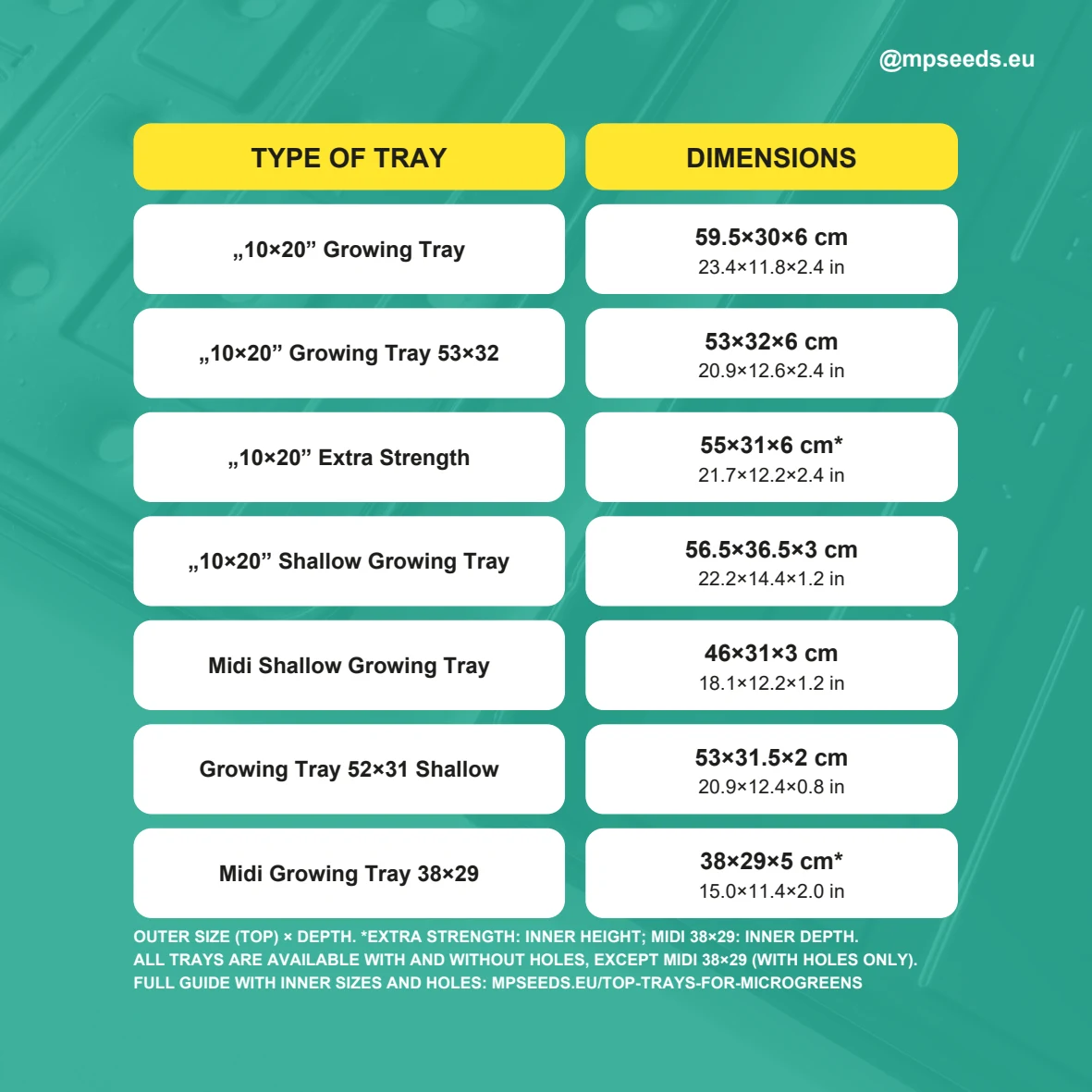
Before you buy, measure two things: the length and depth of the shelf or windowsill where the trays will stand, and the area lit by your lamp if you use one. Then choose one model and buy it as a pair, with and without holes. The table below gives a starting point; the size tables further down give the exact dimensions.
2. What are microgreen trays and how do you use them?
Microgreen trays are shallow plastic containers in which you sow seeds densely on a mat or a thin layer of growing medium. To use them, put a moist mat or medium in a tray with holes, sow, cover the seeds for the blackout days, water from below through a tray without holes and cut the greens above the medium.
A tray does three jobs at once. It holds the growing medium in an even layer. It lets you water from below, which keeps the leaves dry. And it turns every crop into a unit you can lift, move, stack and clean, which matters as soon as you grow more than one tray at a time. A 6 cm deep tray can also hold small pots, so you can grow several varieties side by side.
How to grow microgreens in a tray:
- Prepare the tray. Put a moistened CocoMat or a thin layer of growing medium, such as coco coir or peat substrate, into the tray with holes. Spread it evenly, so the whole surface is equally moist.
- Sow. Spread the microgreen seeds evenly over the surface. How much seed you need depends on the variety and on the tray size: see How densely to sow microgreen seeds.
- Blackout. Cover the crop for the first days, for example with a tray without holes; how long depends on the variety, so check its instructions (blackout days).
- Water from below. Put the tray with holes into a tray without holes and pour water into the lower one. The medium absorbs it; the leaves stay dry.
- Harvest and clean. Cut the microgreens above the medium, remove the used mat with the roots and clean the tray before the next crop: How to clean and sanitize seed trays.
3. Types of microgreen trays
Standard "10x20" trays (6 cm deep) are the most common format for home and commercial growing. The depth leaves room for a thicker layer of medium, for crops with a large root mass such as peas and sunflower, and for pots placed inside the tray.
Shallow trays (2-3 cm) use less growing medium and let you cut close to the base, by hand or with a harvesting machine. They suit quick crops such as radish, broccoli and mustard, and germination on a thin mat.
Midi and small trays are made for windowsills, kitchen counters, small racks and test batches. They are the easiest way to try a new variety without filling a full-size tray.
Heavy-duty trays such as our Extra Strength tray are made of more flexible material than standard trays, which matters when you lift, carry and wash trays every day.
Pairs of trays with and without holes are the basis of bottom watering: the growing tray drains, and the lower tray holds the water.
Hydroponic trays are large Ebb & Flow trays for flood-and-drain and drip systems on racks and growing tables.
4. Microgreen tray sizes: what "1020" really means
"1020" or "10x20" is the industry name for a tray nominally measuring 10 x 20 inches (25.4 x 50.8 cm). It is a size class, not an exact measurement: typical 1020 trays sold in the US measure about 21 x 11 inches (54 x 28 cm) on the outside, and every manufacturer's model is slightly different. Our trays sold as "10x20" are not standard US 1020 trays: they are similar, but each model has its own dimensions, so compare the actual dimensions below with your shelf, rack or light before you buy.
Three measurements matter, and each answers a different question. The outer top size tells you whether the tray fits on your shelf and under your light, and how many trays stand side by side. The inner size tells you how much growing area you really get; to check whether a mat lies flat, compare it with the inner bottom size, because a size measured at the top edge is larger. The depth tells you which crops the tray suits and how much medium you will use. A tray that is 2 cm wider than your shelf, or a mat that is 1 cm wider than the tray bottom, is a problem you only notice when you start sowing.
Outer size and depth:
Inner size and holes:
Read the tables together. The 59.5 x 30 cm tray is the longest, but it is also the narrowest inside (24 cm). The 53 x 32 cm tray is 6.5 cm shorter and wider inside (28 cm), so it is the option when a 59.5 cm tray does not fit your shelf in the direction you want to place it. The shallow 56.5 x 36.5 cm tray has the largest inner area of a single tray in our "10x20" family; how many trays fit on a shelf depends on the shelf itself. Combine trays of the same model only: different models may not fit inside each other, even if they are all called "10x20". A comparison of outer sizes and depths is also available as a PDF to download at the end of this article.
[product id="88, 184"]
5. How deep should a microgreen tray be?

A 2-3 cm deep tray is enough for most microgreens; choose 5-6 cm for peas, sunflower and growing in pots. Microgreens are harvested young, usually when 5-7 cm tall, so they do not need deep soil.
Depth is a trade-off. A shallow tray needs less growing medium per crop and lets you cut close to the base, which gives clean, long stems. A deeper tray holds more medium and more water, which suits large seeds that build a dense root mat, and the pot capacities on our product cards are given for our two 6 cm trays. If a tray is too deep for the crop, cutting close to the base is harder; you can then harvest by lifting the whole mat with the plants.
6. Trays with or without holes?

Not every tray needs holes, but a bottom-watering setup needs both kinds. Trays with holes drain excess water; trays without holes hold it. The most practical solution is a pair of the same model:
- Put the tray with holes, filled with growing medium or a CocoMat, inside the tray without holes.
- Pour water into the lower tray.
- The medium absorbs water from below; the leaves stay dry, and you can pour away any water left after a while.
Why it matters: dense microgreens leave little room for air between the leaves, and water poured from above stays on them. Watering from below keeps the leaves dry and lets you control how much water the medium takes up. Overwatering is one of the main causes of seedlings collapsing at the base (damping-off): university extension services note that the organisms behind it are more active in wet soil.
A tray without holes can also cover the crop during the blackout period, or serve on its own for growing on a mat when you water carefully from above.
7. Material and durability

Our 59.5 x 30 cm "10x20" Growing Tray is made of thick polystyrene for repeated use. The Extra Strength tray is made exclusively for us from recycled PE and is much more flexible than the standard version; it is currently available in grey. The shallowest trays are the lightest: 160 g for the 2 cm and Midi trays, with 1.2 mm walls on the 2 cm tray.
The standard 6 cm trays are sold in packs of 3, 10, 30 or 50, so you can start with a few pairs and buy in bulk once your setup is fixed. Whatever the material, clean the trays after every harvest: How to clean and sanitize seed trays.
8. Which tray for which setup?
A windowsill or kitchen counter. Start with one or two pairs of the Midi tray (46 x 31 cm) or the 2 cm shallow tray (53 x 31.5 cm). Measure the sill first: the depth of a windowsill is often the limiting dimension, not its length.
A home rack with lights. Measure the shelf and the area lit by your lamp, then check how many trays of each model fit in it: the 59.5 x 30 cm tray needs a long shelf, the 53 x 32 cm tray is 6.5 cm shorter, and the shallow 56.5 x 36.5 cm tray has the largest area of a single tray.
A small farm selling cut microgreens. Use one model throughout, so every pair nests and every mat fits. Choose the Extra Strength tray if trays are carried and washed daily, and the shallow tray if you cut with a harvesting machine.
Selling living microgreens. Grow in pots placed in a 6 cm tray: you water the whole tray at once and sell each pot separately.
A hydroponic farm. Use Ebb & Flow trays on the growing tables and place your growing trays or pots in them.
9. Our microgreen trays one by one
"10x20" Growing Tray, 59.5 x 30 cm, 6 cm deep
The longest of our standard trays, made of thick polystyrene for repeated use. It holds 18 pots of the 8 x 8 cm model. The perforated version has 24 holes of 15-20 mm. Choose it for peas, sunflower, pots and bottom watering in pairs. See the tray.
"10x20" Growing Tray 53x32 cm, 6 cm deep
The same depth as the standard tray, but shorter and wider. The perforated version has 20 smaller 10 mm holes; the tray holds 18 pots of the 8 x 8 cm model or 8 of the 10 x 10 cm model. Choose it when a 59.5 cm tray does not fit your shelf. See the tray.
[product id="88, 212"]
"10x20" Extra Strength Growing Tray, 55 x 31 cm
Made exclusively for MP Seeds from recycled PE, more flexible than the standard trays and designed for growers who handle trays every day. The perforated version has 58 holes measuring 13 mm. See the tray.
"10x20" Shallow Growing Tray, 56.5 x 36.5 cm, 3 cm deep

A wide, shallow tray: less growing medium, good airflow around the plants and easier cutting, including with harvesting machines. The perforated version has 45 holes measuring 13 mm; matching CocoMat 33 x 53 cm. See the tray.
[product id="112, 146"]
Midi Shallow Growing Tray, 46 x 31 cm, 3 cm deep
A size for home growing: at 46 x 31 cm it suits many windowsills and kitchen counters (measure yours first), and it forms a bottom-watering pair with the same model without holes. It has the same 3 cm depth as the larger shallow tray. Matching CocoMat 27 x 42 cm. See the tray.
Growing Tray 52x31 cm Shallow, 2 cm deep
Our shallowest tray, 53 x 31.5 cm on the outside, light (160 g) and suited to seed starting, germination and short-rooted crops on a thin mat. Choose a deeper tray for crops that develop larger roots. Matching CocoMat 28 x 49 cm. See the tray.
[product id="184, 268"]
Midi Growing Tray 38x29 cm, 5 cm inner depth
A compact grey tray with drainage holes for small racks, test batches and home growing, for soil, CocoMats and hydroponic methods. It is available only with holes, so pair it with a solid tray or saucer of a suitable size for bottom watering. See the tray.
[product id="325, 184"]
All trays are in one place in our growing trays category.
10. Matching CocoMats
A CocoMat cut to a standard size gives an even layer of medium across the tray. The sizes below are the ones recommended on our product cards:
For the 6 cm trays (59.5 x 30 cm, 53 x 32 cm and Extra Strength), check the mat against the inner bottom of the tray before you buy; the table above gives the inner size as stated on each product card. See all CocoMats.
11. Growing pots: what they are and how they differ from trays
Growing pots are small plastic containers with drainage holes in the bottom. They split one tray into separate units: each pot can hold a different variety, a small test batch or a portion of living microgreens that you sell on its own. You place the pots in a 6 cm deep tray and water them together from below.
Pots also change how you sell. A tray of cut microgreens is harvested at once and packed; a pot can stay alive until the customer cuts it at home. The low pots (4-5 cm) show the whole plant and are a good choice for presenting and selling microgreens.
How many pots fit in a tray, as stated on our product cards:
The model name of a pot is not always its outer size: the 10 x 12 cm low pot measures 14 x 12 cm at the top, for example. The capacities above are given for these two trays; for other trays, check the pot dimensions before you buy. See all growing pots.
[product id="90, 194"]
12. Hydroponic trays for Ebb & Flow systems
For larger farms and hydroponic setups we offer Ebb & Flow hydroponic trays. In a flood-and-drain system, a pump periodically floods the tray with water or nutrient solution, which then drains back to the reservoir; your growing trays or pots stand in the hydroponic tray and take up water from below. All four sizes are made of 3 mm thick, UV-proof virgin plastic, are 5.6 cm deep and have integrated channels that lead water to the outlet.
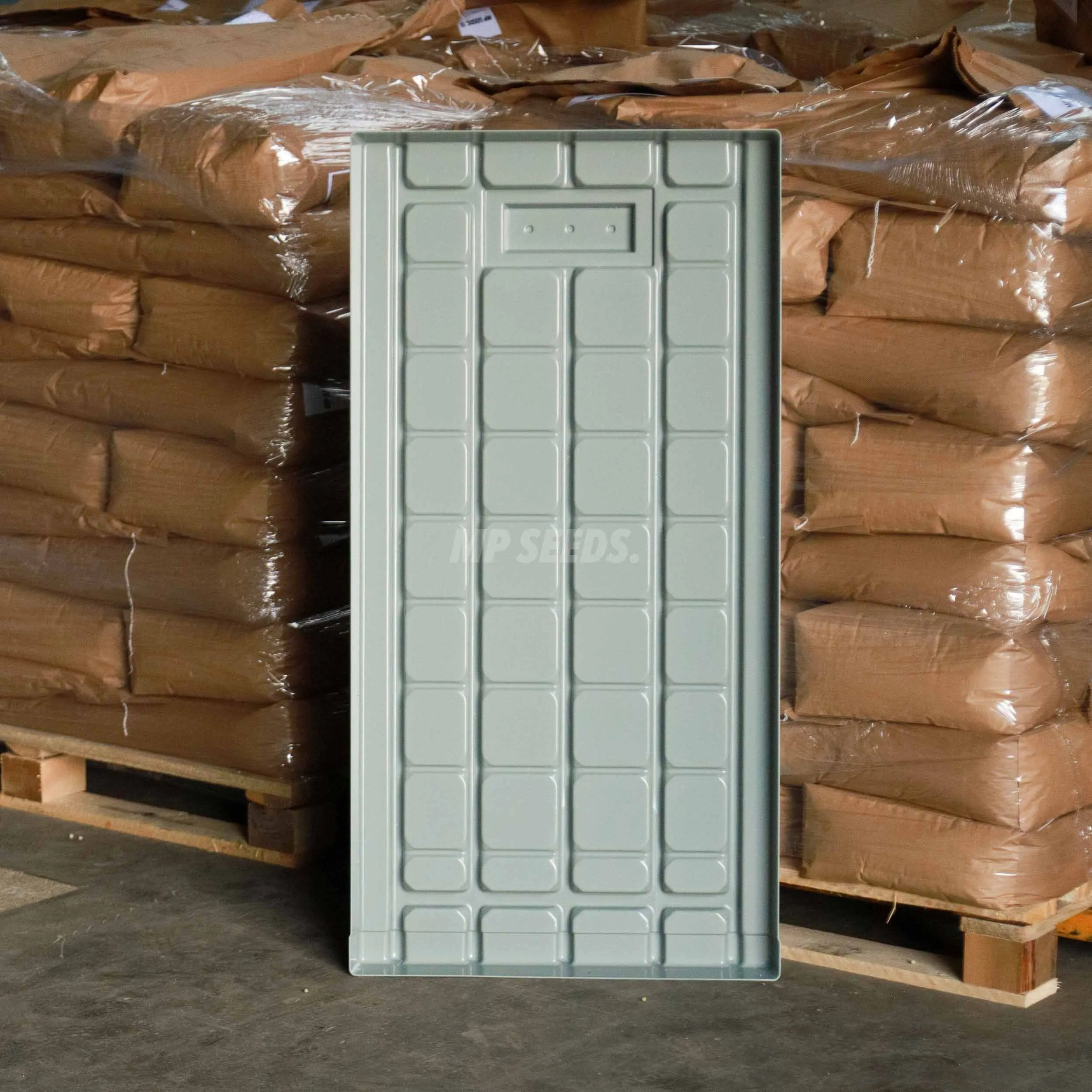
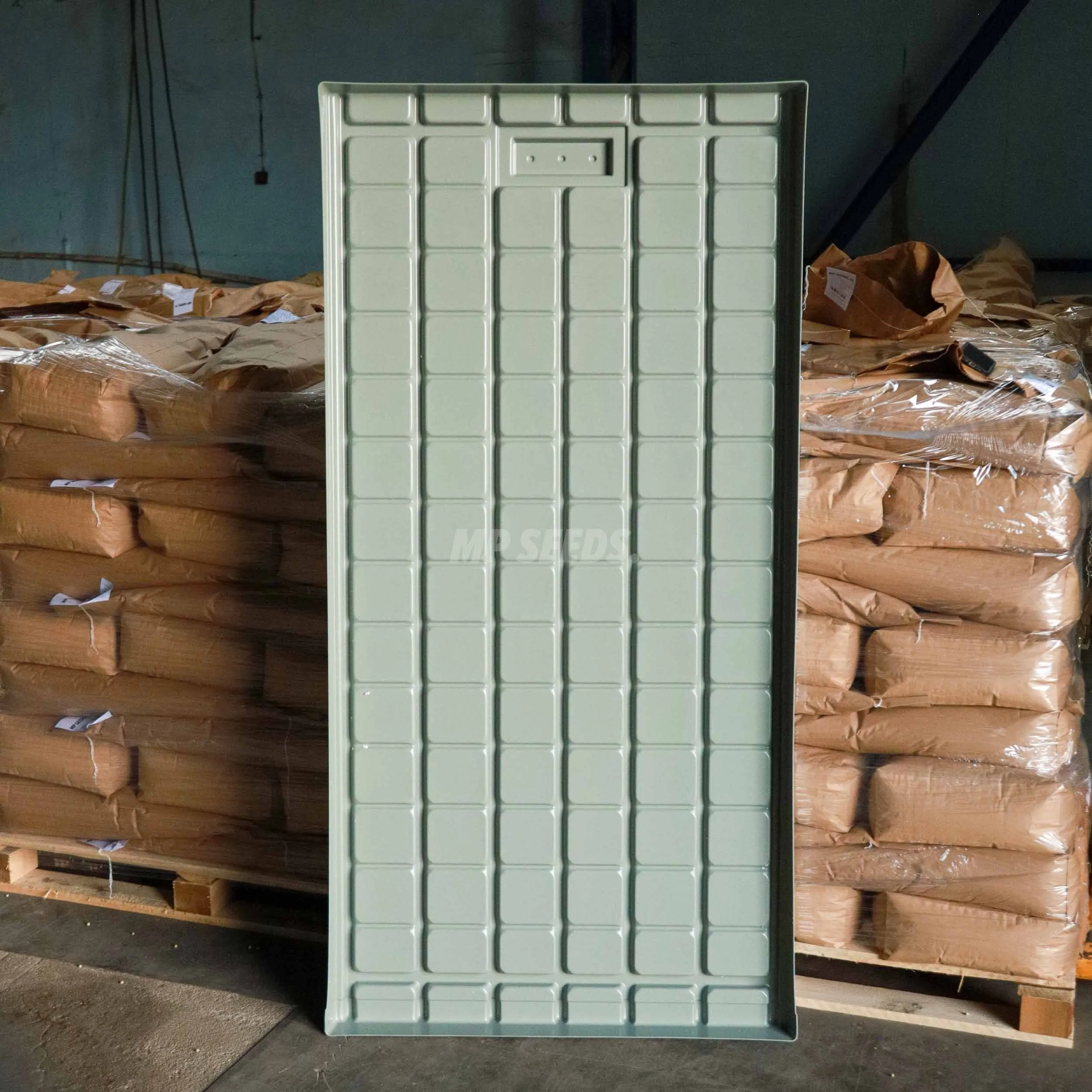
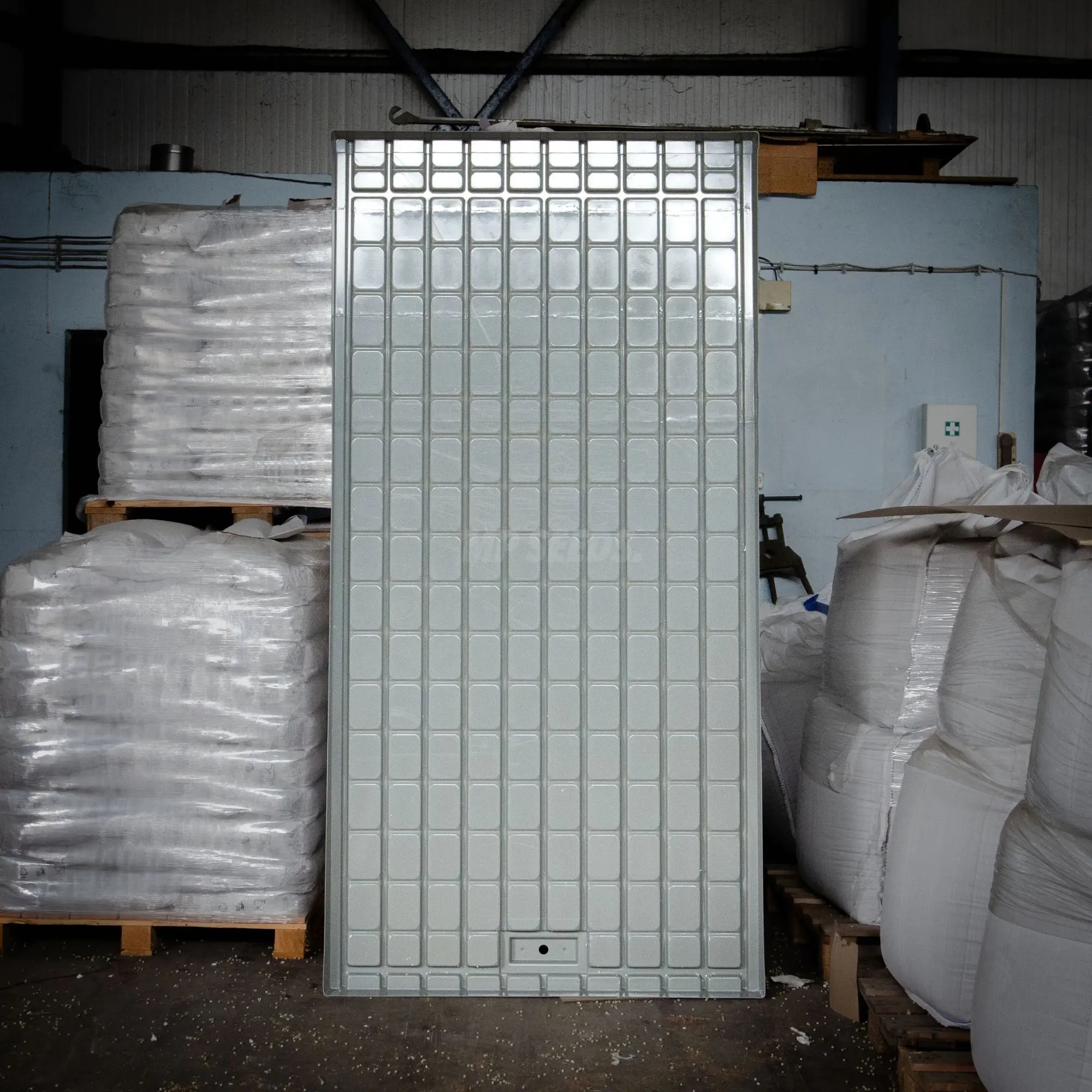

Our product cards recommend a maximum water height of 1 cm during irrigation, which irrigates the roots without soaking the seeds. The trays also work with drip irrigation; each card describes the setup for its size.
[product id="302, 303"]
13. DIY microgreen trays: what to check
You can grow microgreens in a home-made tray, for example a food container. University extension services list household containers such as cut-off milk cartons and plastic jugs for seed starting, provided holes are punched in the bottom for drainage. Check four things:
- Material: use a clean container intended for food contact, without cracks.
- Drainage: make holes in the bottom of the growing container and put it into a second container without holes, so you can water from below.
- Depth: 2-6 cm is enough; deeper containers make cutting harder.
- Size: a flat bottom that fits your mat or holds a thin, even layer of medium.
A home-made container is a simple way to try growing microgreens. For regular growing, a pair of trays made for the purpose gives you known dimensions, a matching mat size and a lower tray that fits.
FAQ
What is the best tray for microgreens at home?
A pair of trays of the same model, one with and one without holes. On a windowsill, a Midi tray (46 x 31 cm) or a 2 cm shallow tray is usually enough.
What size is a 1020 tray?
Nominally 10 x 20 inches (25.4 x 50.8 cm), but real trays differ. Our "10x20" trays measure from 53 x 32 cm to 59.5 x 30 cm on the outside; the shallow version is 56.5 x 36.5 cm.
Do microgreen trays need holes?
For bottom watering, yes: the growing tray has holes and the lower tray without holes holds the water. If you grow on a mat and water carefully from above, a tray without holes also works.
Do I need to cover microgreen trays?
Many varieties are kept in darkness (blackout) for the first days after sowing; how long depends on the variety, so check its instructions and our guide Germination and blackout days in microgreen growing. A tray without holes placed on top works as a cover.
Can I put one tray inside another?
Buy two trays of the same model, one with and one without holes. Different models, even if all called "10x20", have different dimensions and may not fit inside each other.
How much seed do I need per tray?
It depends on the variety and the tray size. See How densely to sow microgreen seeds or enter your tray dimensions in the seed density calculator.
How many pots fit in a 10x20 tray?
Our "10x20" Growing Tray (59.5 x 30 cm) holds 18 pots of the 8 x 8 cm model, 10 of the 10 x 10 cm model, 10 of the 10 x 12 cm model or 6 of the 10 x 14 cm model.
Summary
Choose the tray by the space you have and the crops you grow: 6 cm for peas, sunflower and pots, 2-3 cm for quick crops, Midi trays for a windowsill. Compare real outer dimensions with your shelf and inner dimensions with your mat, not the "1020" label. Buy trays in pairs of the same model for bottom watering, stay with one model as your setup grows, and clean the trays after every harvest. All models are in our growing trays category.
Sources and Further Reading:



 Menu