Just enter your tray dimensions and the calculator will provide precise seeding rates, soaking instructions, blackout days, and growing time.
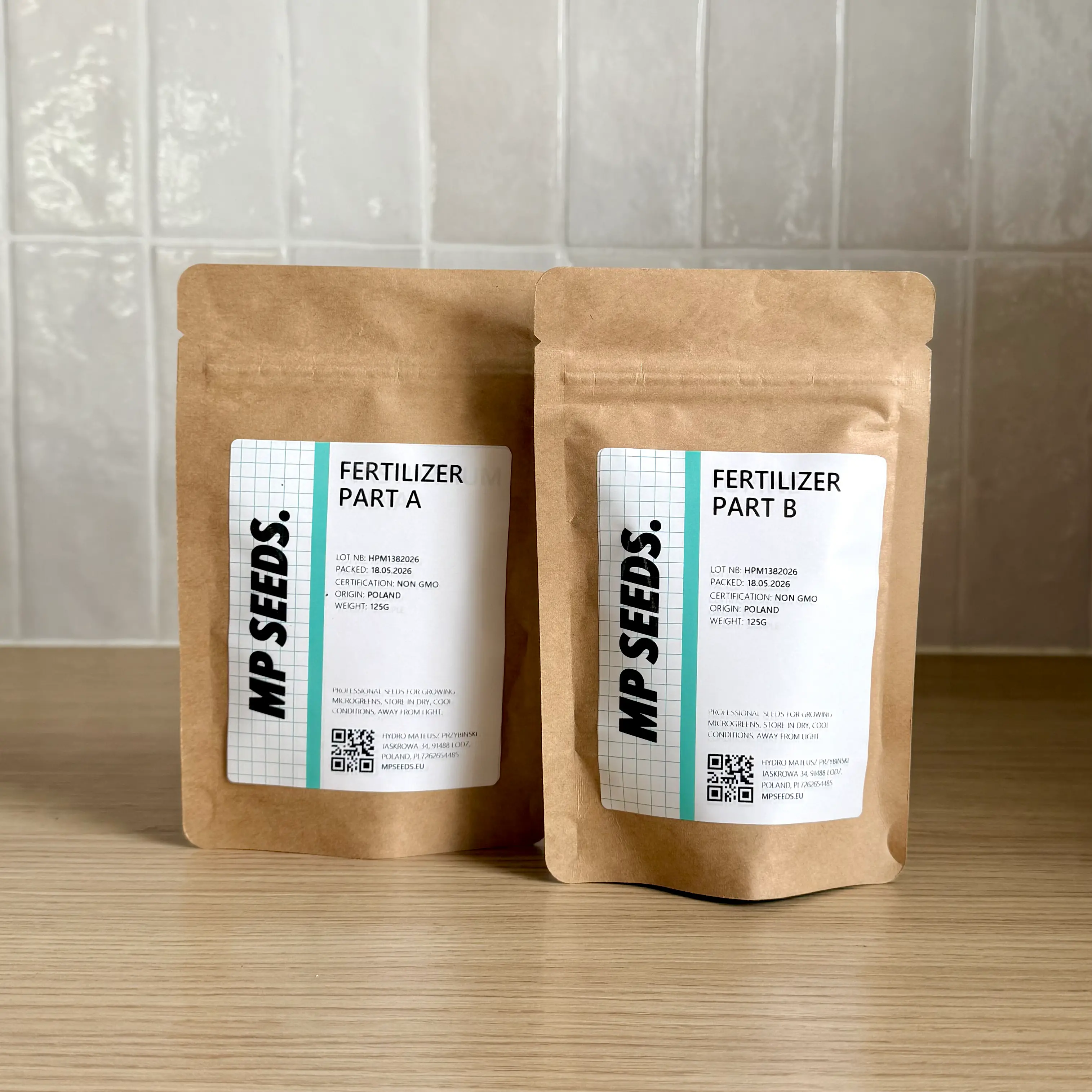
Fertilizer A+B for microgreens
Availability:
available
Dispatched within:
up to 2days
Price:
€6.00
including Polish VAT
Regular price:
The lowest price during 30 days prior to the reduction:
product unavailable
* - field mandatory
Product code:
FERTILIZER
 Description
Feritilizer DIY for growing Microgreens!
Looking for a reliable fertilizer made especially for microgreens? You've come to the right place! Our MP SEEDS mineral fertilizer is designed to support strong, healthy growth for all your microgreen varieties.
What Do You Get?
When you order this product, you’ll receive two separate bags of fertilizer:
- Bag with a part A
- Bag with a part B
These parts are stored separately to prevent chemical reactions that could reduce their effectiveness. You’ll mix them with water separately before use—details below.
Additionally make sure to store your fertilizer in a shaded place.
New batch update: Please note that the latest batch of Fertilizer comes in a red color. This is only a visual change – the product works exactly the same and provides identical results as before.
How to Prepare the Fertilizer?
You’ll need two containers:
- Mix 1g of Part A with 1 liters of water in one container.
- Mix 1g of Part B with 1 liters of water in another container.
Never mix Part A and Part B together in the same container. Always keep them separate.
How to Use the Fertilizer?
- First water your microgreens once with Part B solution,
- Next time, water them once with Part A solution.
- Start fertilizing after the blackout phase, when your plants are first placed under light.
For most microgreens, one watering with Part B and one with Part A is enough.
For longer-growing varieties, such as micro herbs, you may repeat the fertilization (Part B + Part A) after one week under light.
When Is Fertilizer Recommended?
- Recommended: For all microgreens with small seeds (e.g., Amaranth, Broccoli, Basil).
- Not required: For microgreens with large seeds (e.g., Pea, Fava Bean), unless...
If you’re growing on Coco Coir or Coco Fiber Mats, fertilizer is mandatory, since these substrates do not contain any natural nutrients.
Why Microgreens Need Fertilizer
Microgreens grow quickly and require a steady supply of nutrients to thrive, which is why using a micro green fertilizer can significantly boost their health and growth. A high-quality microgreen liquid fertilizer ensures your plants get immediate access to essential minerals. Even though they are harvested young, microgreens still benefit from targeted nutrition to maximize their yield, flavor, and appearance.
Advantages and contents of microgreen' fertilizer?
- Lack of coating, high purity, and excellent solubility - safe to use without the risk of clogging drippers and spray nozzles (applies for bigger farms).
- Absence of heavy metals and phytotoxic substances: guarantee of safety for plants and humans.
- Impact on yield - fast-acting, nitrate form of nitrogen is absorbed immediately after application.
- High content of readily available calcium - influences the healthy development of the root system, improves the appearance, taste, firmness, post-harvest durability of flowers, and storage properties of vegetables and fruits, reduces their susceptibility to fungal diseases and damage during transportation.
- High content of chelated micronutrients (EDTA) to fulfill plant requirements, even in inert substrates.
- Positive impact on soil structure and stabilization of pH in the root environment.
- Suitable for foliar feeding and fertigation.
- Contains essential components for proper development and growth, including macronutrients calcium, nitrogen, phosphorus, and potassium, as well as magnesium, sulfur, and micronutrients such as iron, zinc, manganese, boron, copper, and molybdenum.
- Proportions and quantities of nutrients are universally formulated to meet the nutritional requirements of microgreens.
Get our specially formulated fertilizer today and start seeing results in no time!
Can I use fertilizer for organic crops?
Organic farming only uses natural fertilizers and nutrients. Our fertilizer is mineral, so it's not suitable for organic farming.